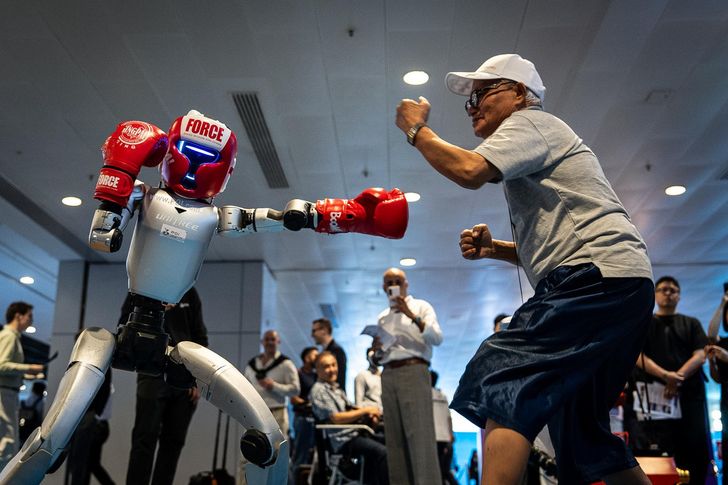
Humanoid robots, once a staple of science fiction, are now becoming a reality as they transition into practical applications. Major tech companies and startups are investing heavily in this technology due to its potential to operate in human environments and perform a variety of tasks, addressing labor shortages and hazardous work conditions. The global momentum behind humanoid robots is growing rapidly, with China’s ecosystem expanding and key players like 1X Technologies, Agility Robotics, Apptronik, Tesla, and Samsung leading the charge in commercial deployment. The focus is on developing safe, reliable, and affordable robots for industrial use initially, with applications for domestic roles on the horizon. This shift signifies AI’s increasing presence in the physical world.
Humanoid robots are poised to revolutionize various industries due to their ability to operate in spaces designed for humans, use human tools, and adapt to different tasks without requiring major environmental modifications. Companies like 1X Technologies are pioneering the development of domestic humanoid robots, such as the Neo, designed to assist with everyday household chores. On the other hand, Chinese company AgiBot stands out for its large-scale delivery of highly dexterous humanoid robots capable of intricate tasks.
Agility Robotics is focusing on practical applications by developing robots like Digit for warehouse and logistics settings, aiming to demonstrate that humanoids can be deployed in operational environments effectively. Apptronik’s Apollo robot, designed for factory and logistics work, showcases the company’s commitment to industrial applications. Boston Dynamics, known for its highly mobile robots, is shifting its focus towards industrial labor roles, while BYD, primarily an electric vehicle manufacturer, is also delving into humanoid robotics to enhance efficiency in manufacturing processes.
In China, Engine AI is gaining attention for its humanoid robots’ natural movement, while Figure AI has made strides in deploying robots for vehicle production processes. Neura Robotics from Germany emphasizes safety features such as synthetic skin on its humanoid robots. Noble Machines, a California startup, targets dangerous and physically demanding jobs with its humanoid technology.
Large companies like Samsung and Toyota are exploring the integration of humanoid robots into their manufacturing processes, with a focus on improving efficiency and safety. Sanctuary AI’s Phoenix robot stands out for its emphasis on intelligence and dexterity, showcasing advanced motor control capabilities. Tesla, led by Elon Musk, is ambitiously venturing into humanoid robotics with its Optimus project.
While humanoid robots hold immense potential across various industries, challenges such as safety, reliability, affordability, and practical utility need to be addressed. The cautious adoption of humanoid robots in controlled environments like factories and warehouses is expected to precede their integration into homes and healthcare settings as technology matures. Despite the excitement surrounding humanoid robotics, it is crucial to approach this evolving technology with a balance of optimism and caution, considering that the field is still in its early stages. The future of technology lies in creating humanoid robots that prove beneficial and user-friendly in practical scenarios, ultimately shaping the next chapter in technological evolution.
About the Author