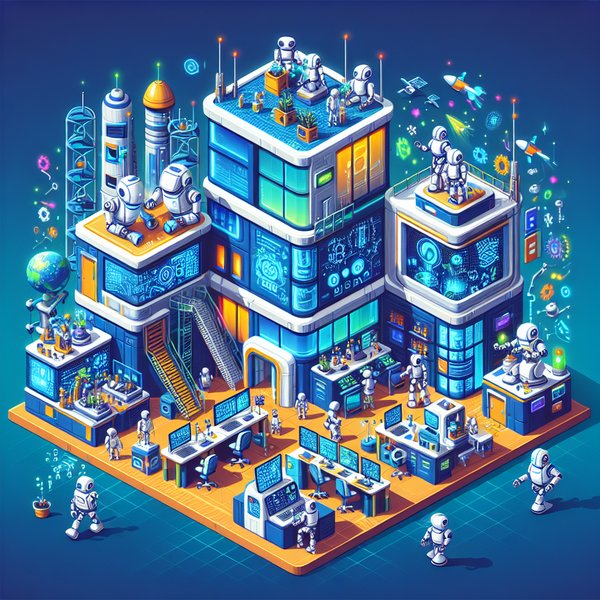
Naver, a leading South Korean technology company, is enhancing its artificial intelligence capabilities by integrating robots into its headquarters while intensifying investments in cutting-edge technologies. The firm’s second headquarters in Seongnam, located south of Seoul, serves as a testing ground for various AI and robotics applications. The expansive building, spanning from a basement to 28 above-ground floors, is home to about 100 service robots, known internally as “Rookie.”
These robots play a crucial role in assisting employees by delivering food, beverages, packages, and handling document transportation within the building. Through a dedicated mobile application, workers can easily summon these robots and authenticate their identity upon arrival. What sets these robots apart is their ability to autonomously navigate the entire building, bypass security gates, ride elevators, and move between floors without human intervention, a feature uncommon in robots usually restricted to specific areas.
Naver Labs, the company’s research arm focused on advancing automation systems, is spearheading the development of robotics technology within the facility. Various types of robots, from wheeled service units to bipedal machines, are being tested to establish a comprehensive robotics ecosystem. A pivotal element of this system is the “ARC Brain,” a cloud-based platform that facilitates centralized control and coordination of multiple robots, enhancing operational efficiency by allowing the simultaneous management of a fleet of machines.
Company officials emphasize the importance of enhancing productivity through the deployment of robots to undertake tasks traditionally performed by humans. This necessitates an integrated system capable of overseeing multiple robots concurrently. In addition to robotics, Naver is bolstering AI features in its primary search business, with plans to introduce an “AI tab” following the successful rollout of its AI briefing service last year.
Naver achieved record-breaking results in 2025, with revenue reaching 12.35 trillion won ($8.2 billion) and operating profit of 2.21 trillion won ($1.47 billion). Market projections indicate that the company is on track to set another record this year, with anticipated revenue of 13.41 trillion won ($8.9 billion) and operating profit of 2.45 trillion won ($1.63 billion). The company’s strategic focus on AI and robotics underscores its commitment to innovation and technological advancement in the fiercely competitive tech landscape.
About the Author