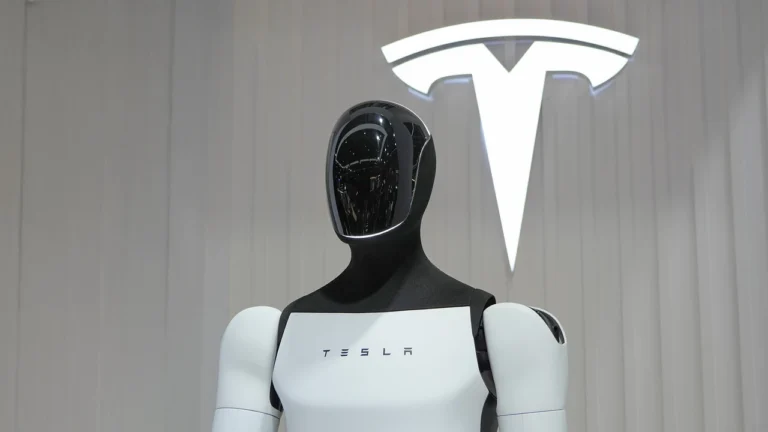
Evolution of Tesla: Transitioning from an Automotive Manufacturer to a Robotics Giant
What once sounded like a distant vision of CEO Elon Musk is now taking concrete shape at Tesla. Could the next big breakthrough platform be emerging in the form of humanoid robots? Although the global market for humanoid robots is still in its infancy, growth expectations are extraordinary. Analysts at Goldman Sachs project that by 2035, the market could reach a volume of $150 to $200 billion with annual growth rates exceeding 40%. By 2030, over a million humanoid robots could be deployed worldwide, initially in industries like manufacturing, logistics, and healthcare, and later branching into the service sector. To put things into perspective, the current annual market size for industrial robots stands at around $16 billion. Humanoid robots are poised to structurally expand this category, not replace it, but complement it.
At the forefront of this technological evolution is Tesla. With its humanoid robot named Optimus, the company is taking a radically different approach compared to traditional robotics manufacturers. While competitors focus on specialized tasks, Tesla aims to develop a universally adaptable workforce. Standing at approximately 1.73 meters tall, weighing around 70 kilograms, capable of carrying up to 20 kilograms, and controlled by the same AI systems as Tesla’s vehicles, Optimus represents a new frontier in robotics technology.
Access to the full article would require registration. By registering for a free account, you can delve into exclusive insights and updates on the evolving landscape of humanoid robotics. Elon Musk’s innovative integration of SpaceX with XAI, and the advancements by rivals like Waymo, are shaping a compelling narrative in the realm of robotics.
As the boundaries of technology continue to push forward, Tesla’s venture into humanoid robotics marks a significant leap towards a future where versatile robots could revolutionize industries and services.
About the Author