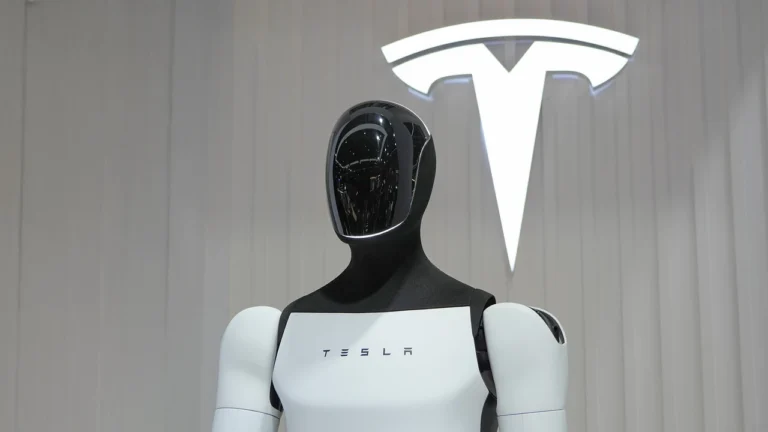
Konstantinos Laskaris, the Tesla Lead Director of Optimus, recently shared insights on Optimus 2.5 and its predecessors at the ETH Robotics Club INSPIRE Talk in Switzerland. During his presentation, he debunked the notion of a sim-to-real gap, emphasizing the importance of accurately modeling robots. He highlighted that hardware plays a crucial role in replicating human motion and stressed the superiority of tendon-driven hands over motor-driven systems due to physics constraints.
Challenging the robotics community to deepen their understanding of physics, Konstantinos encouraged building custom simulations to meet specific fidelity requirements. He also teased the upcoming Optimus V3, which will be exclusive to Tesla and utilized in their Bot Academy, where robots learn tasks like operating a drill from scratch in a secure environment.
On the other hand, Brian Wang, a prominent Futurist Thought Leader and Science blogger, continues to disrupt the tech industry with his blog Nextbigfuture.com. Known for his insights into cutting-edge technologies such as Space, Robotics, Artificial Intelligence, and Nanotechnology, he is actively involved in high-potential startup ventures and deep tech investments.
Regarding Tesla’s robotics developments, there is a mention of Optimus V3 not being intended for public sale or factory deployment, raising speculation about its initial production phase and internal use within Musk’s enterprises. The focus seems to be on initial limited production for internal applications rather than commercial sales. Brian also reflects on the challenges and strategies Elon Musk faces in showcasing AI advancements effectively and maintaining a competitive edge in the fast-evolving tech landscape.
The discussion around tendon-driven hands as a solution for replicating human-like dexterity in robotics highlights the innovative approach to enhancing capabilities beyond traditional motor-driven systems. This shift in approach leverages new technology to achieve a balance between delicate tasks requiring finesse and heavier-duty operations, showcasing the evolving nature of AI and robotics in practical applications.
Looking ahead, as AI robotics progress in real-world environments, industries like automobile manufacturing and ship welding are poised to benefit from these advancements, transforming the way tasks are performed. The intersection of AI, robotics, and practical testing holds promise for enhancing efficiency and productivity across various sectors.
About the Author