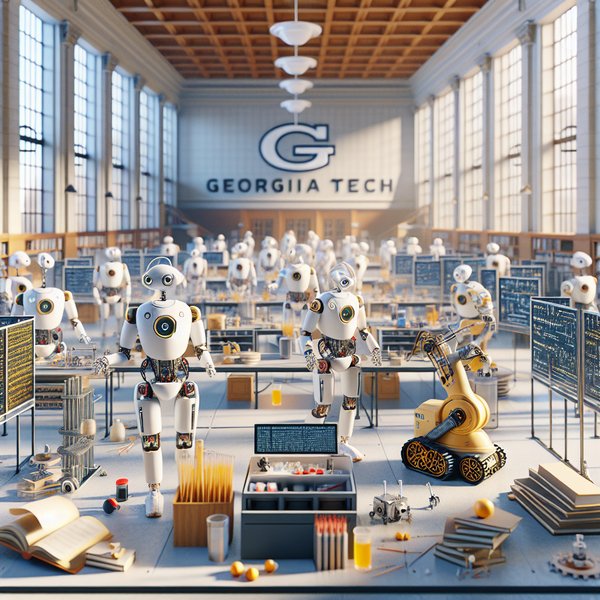
Researchers at Georgia Tech have made significant progress in the field of robotics, paving the way for a potential shift in the workforce landscape. Robots are not just limited to hazardous tasks like mining or high-speed mass production but are now being developed to undertake more intricate and delicate tasks that have traditionally required human dexterity and coordination.
Imagine robots proficiently stacking cups, folding towels, packing food, and arranging fruit on plates – tasks commonly seen in hospitals, care facilities, childcare centers, and restaurants. While this advancement may be welcomed by business owners aiming to maximize profits by reducing labor costs, it raises concerns for those whose livelihood depends on these roles or cities reliant on taxpayers engaged in such work.
The breakthrough achieved by Georgia Tech researchers, including Nadun Ranawaka Arachchige and Zhenyang Chen, focuses on enhancing robots’ ability to perform domestic and retail tasks with precision and efficiency comparable to, if not better than, human capabilities. Key to their innovation is the AI-based Speed Adaptation of Imitation Learning (SAIL) system, which integrates robotics, mechanical engineering, and machine learning.
The SAIL system incorporates algorithms that ensure smooth, consistent motion at high speeds, precise motion tracking, adaptive speed adjustments based on task complexity, and action scheduling to address real-world latency. In experiments involving 12 simulated and two actual tasks, robots equipped with SAIL technology operated up to four times faster in simulations and 3.2 times faster in reality compared to conventional systems.
Unlike previous robot models limited by human demonstration speeds for task imitation, SAIL overcomes this constraint, significantly enhancing robotic performance and efficiency. The system’s ability to adjust speed dynamically based on environmental changes and task requirements represents a substantial leap forward in robotic technology.
While SAIL is a remarkable advancement in automating human-scale tasks, it also raises concerns about the potential impact on the job market. Studies suggest that by 2030, automation could lead to the displacement of hundreds of millions of jobs globally, necessitating significant workforce reallocation and adaptation.
As the debate on the implications of widespread automation continues, it is essential to consider the broader economic and social implications of such technological advancements. The future balance between human labor and robotic automation remains a critical issue that requires careful consideration and planning to mitigate potential disruptions and ensure sustainable economic growth and social stability.
In conclusion, while robots are poised to revolutionize various industries and drive efficiency and productivity gains, it is crucial to approach automation strategically to ensure a harmonious integration of human and machine labor for the benefit of society as a whole.
About the Author