Enhancing Human-Robot Interaction in Manufacturing Systems
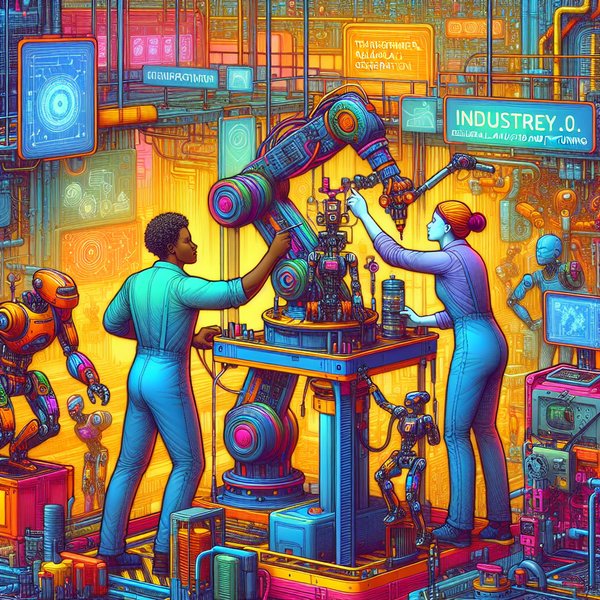
Artificial Intelligence (AI) and robotics have revolutionized modern manufacturing through Human-Robot Interaction (HRI) systems, improving productivity, efficiency, and adaptability. However, traditional robotic systems often struggle with real-time decision-making, knowledge retrieval, and adaptive learning in dynamic environments. To tackle these challenges, Retrieval-Augmented Generation (RAG) and fine-tuned Transformers offer promising solutions by allowing robots to retrieve relevant information, optimize task execution, and continuously learn from human feedback.
In industrial production settings, robots are tasked with complex, sequential operations like assembly, quality inspection, and maintenance. While conventional automation relies on pre-set programming, these new approaches enable robots to adapt to variations, uncertainties, and human interventions. This research introduces a regret-based learning model that enables a human-robot production system to minimize performance regrets over multiple learning cycles.
The study integrates RAG for dynamic knowledge retrieval, fine-tuned Transformers for task optimization, and regret-based learning to enhance robotic decision-making continually. The main objectives are to develop a robust HRI framework for real-time knowledge retrieval and task adaptation, implement a regret-based optimization model to minimize errors and human interventions, and evaluate system performance numerically in a production environment.
The proposed human-robot production system consists of key components such as a human operator providing instructions, RAG module for knowledge retrieval, Transformer Neural Network for task planning, Regret Model for performance assessment, Robot Execution Module, and Sensor Feedback Loop. Through iterative fine-tuning, the robot learns from past mistakes, reduces errors, and improves efficiency over multiple production cycles.
This study contributes to the field of adaptable automation, AI-driven manufacturing, and collaborative robotics by enhancing robotic learning capabilities through regret-based reinforcement learning, integrating RAG for efficient knowledge retrieval, reducing human interventions, and improving robot autonomy and efficiency. The research aims to bridge the gap between AI-driven learning models and real-world robotic applications, laying the groundwork for the next generation of intelligent, autonomous industrial robots that are efficient, adaptable, and ethically aligned.
Further research is needed to address challenges in scalability, real-time adaptation, multimodal learning, and ethical considerations in the integration of AI and regret-based learning in robotics. By integrating these advanced techniques, the future promises to bring about more efficient, adaptive, and ethical robotic systems that improve human-robot collaboration and automation in various industries.
About the Author