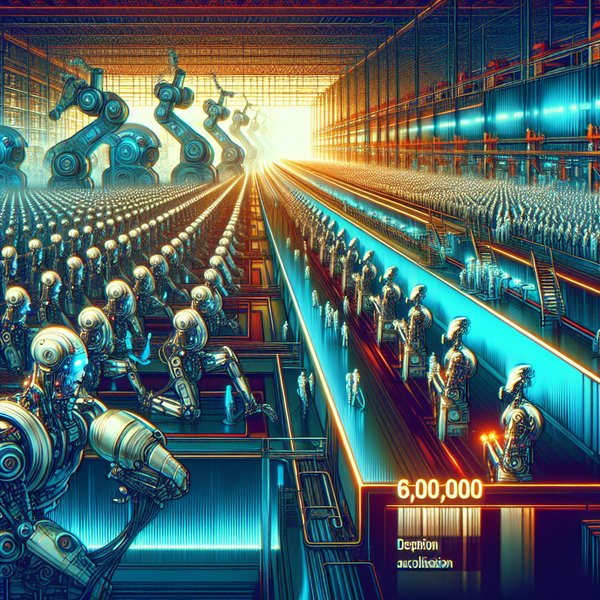
A leaked report on Amazon’s plans to replace hundreds of thousands of workers with robots confirms that artificial intelligence (AI) is revolutionizing employment faster than anticipated. The documents disclosed by The New York Times and The Verge reveal Amazon’s intention to replace 600,000 workers with robotic systems and AI, automating up to 75% of its operations by 2033. In the United States alone, the company would eliminate over 160,000 jobs by 2027.
While Amazon claims to be still hiring, analysts agree that Amazon’s case exemplifies a global phenomenon: automation is progressing faster than companies and employees can adapt. A spokesperson from LiveCareer’s editorial team, which analyzes workforce trends resulting from technological advancements, explained, “Amazon’s case is just the tip of the iceberg. AI will not only replace jobs but will also reshape how we work and which skills will remain essential.”
According to LiveCareer’s recent study, jobs at highest risk of automation in the short term involve repetitive, structured, or easily digitalizable tasks. The report suggests professional transition paths for those looking to adapt. Some examples include data entry clerks transitioning to data analysis and management, customer service representatives moving towards customer experience and advanced technical support.
LiveCareer’s study warns that AI will not destroy human employment but will deeply transform it. They predict that 41% of companies plan to reduce staff by 2030, yet approximately 170 million new jobs will be created, resulting in a net positive balance of 78 million jobs. Administrative, sales, and technical support sectors will be most affected, but new opportunities will arise in data analysis, technology, education, and creativity.
The report recommends that workers enhance their digital and analytical skills by mastering tools like Power BI, Python, or generative AI platforms. It also suggests strengthening soft skills such as leadership, communication, problem-solving, and decision-making. Workers are advised to update their resumes and professional profiles to highlight adaptability and continuous learning, key factors in a transforming job market.
Businesses should view artificial intelligence as a strategic ally rather than just a cost-cutting tool, leveraging it to boost productivity and explore new business models. LiveCareer’s alert aligns with Nobel laureate Daron Acemoglu’s warnings that if Amazon successfully automates its operations, other companies will likely follow suit, potentially turning one of the world’s largest employers into a net job destroyer.
The analysis draws insights from the International Labour Organization (ILO), CNN Business, and CIO, underscoring a clear conclusion: AI will redefine the labor landscape, and those who prepare early will lead the digital economy of the next decade.
About the Author