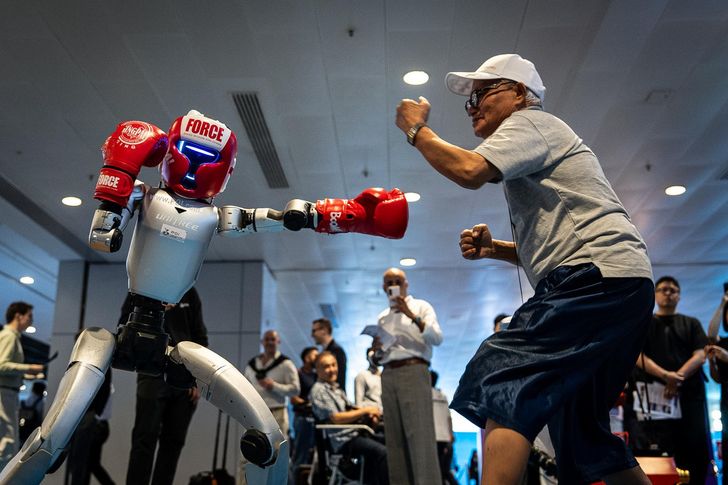
At an exhibition in Hong Kong on April 13, a humanoid robot engaged in a demonstration with a visitor, showcasing its abilities to entertain and communicate effectively. The robot, resembling a primary school student in size, captivated the audience by singing songs, conversing in Mandarin and English, and responding to questions with agility. Over 100 robots were on display at this event held at the Hong Kong Convention and Exhibition Center, including the X2 Ultra robot from AGIBOT Innovation (Shanghai) Technology Co., a prominent Chinese humanoid robot manufacturer.
The X2 Ultra robot demonstrated a wide range of hobbies, from sports and dancing to technology and music appreciation. It showcased its ability to identify individuals in its vicinity with ease, depicting them as “a woman holding a phone, a woman holding a bag and a phone, a man holding a camera.” According to Calvin Chiu, the chief operating officer of Novautek Autonomous Driving, the robot has the capability to provide emotional fulfillment through engaging conversations and can serve as an educational tool for both older adults and children. Moreover, these robots can be programmed with distinctive personalities, offering companionship akin to a friend.
China’s technological landscape has become a key area of competition, particularly with the U.S., and is now a matter of national security concern. In line with Beijing’s latest five-year plan, significant emphasis is placed on the advancement of technology, including humanoid robots, reflecting the country’s commitment to innovation. The plan aims to expedite the development and application of products like humanoid robots, a strategic move for the world’s second-largest economy.
Chinese robotic manufacturers have made remarkable strides, with over 140 humanoid-robot manufacturers and more than 330 models in existence by 2025. AGIBOT, Unitree Robotics, and UBTech Robotics Corp. are among the top-tier vendors, as stated in a report by technology research group Omdia. These companies have demonstrated strong performance, with shipments exceeding 1,000 units of general-purpose intelligent robots, underscoring their competitive edge in the global market.
The exhibition in Hong Kong showcased a diverse array of robotic capabilities, from interactive communication to physical tasks such as backflips and security patrols. Companies like EngineAI displayed their PM01 robot, highlighting its mobility and agility, including the remarkable ability to perform a front flip. Robert Chan from EngineAI highlighted China’s advantages in engineering and emphasized the culture of knowledge sharing among companies, distinguishing it from practices in the U.S. and Europe.
Looking ahead, the future of robotics is envisioned to feature human-like robots capable of emotive interactions and lifelike expressions. Companies are exploring ways to enhance human-robot interactions by infusing warmth, emotion, and decision-making capabilities to enhance user experience. Innovations like robots designed with female features and soft synthetic faces are already in use in settings such as museums and government venues, providing assistance and guidance to visitors.
The integration of humanoid robots in various sectors signifies a shift towards more personalized and emotionally engaging interactions between humans and robots. The potential for robots to resemble humans both in appearance and behavior opens up new possibilities for customer service, education, and entertainment, marking a significant advancement in the field of robotics.
About the Author