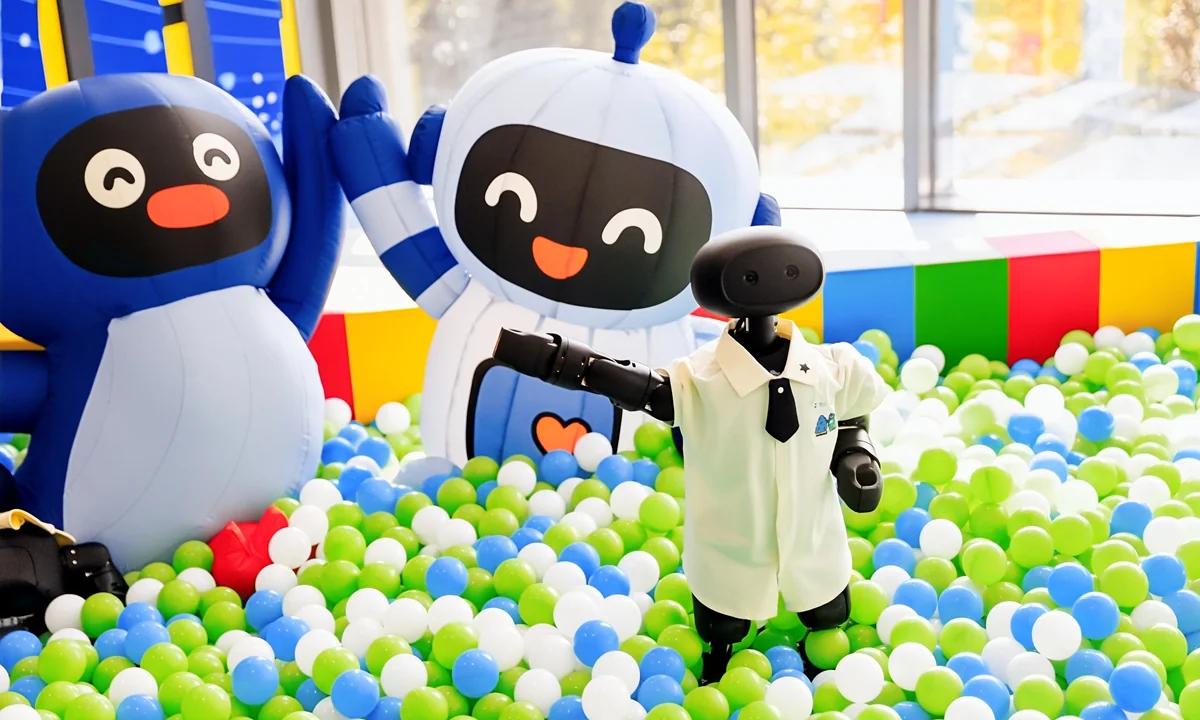
A new pioneering concept in robot education has emerged in China with the establishment of a distinctive “kindergarten” designed for robots. The facility, operated by Tashan Technology, is at the forefront of redefining traditional approaches to machine learning. Unlike conventional methods that involve pre-programming robots with specific actions, researchers are now focusing on enabling robots to learn autonomously by engaging in experiments, making mistakes, and persistently attempting tasks.
The underlying principle of this innovative training approach is to equip robots with the capability to continuously adapt and learn even after they are deployed in real-world scenarios, potentially extending to unfamiliar situations they were not explicitly trained for. For instance, if a robot encounters a setback such as crashing into a wall during training, it can analyze the error, adjust its trajectory, and retry the task. Consequently, failures are transformed into valuable learning opportunities rather than mere setbacks.
Wang Peng, a researcher affiliated with the Beijing Academy of Social Sciences, emphasizes that autonomous exploration of the environment can empower robots to transcend limited training for specific functions. Over time, robots may develop a deeper comprehension of the physical world and the behavior of objects within their surroundings. However, this form of learning is time-intensive, often necessitating hundreds or even thousands of trial-and-error attempts for robots to acclimate to novel situations.
Despite the time investment required, researchers anticipate that the ability of robots to learn from mistakes will play a pivotal role in shaping the future of robotics. Furthermore, there is a vision for robots to eventually exchange knowledge with each other. In this scenario, if one robot successfully tackles a unique challenge or masters a new task, other robots could potentially leverage that knowledge rather than starting from square one.
One intriguing aspect of this new educational paradigm is its resemblance to the way in which young children assimilate knowledge. Children do not merely follow instructions but instead explore, err, and gradually develop an understanding of the world around them. The concept of a “kindergarten” for robots transcends being merely a catchy moniker; it embodies a fundamentally distinct approach to educating machines.
As we provide you with the latest news, we invite you to support open, independent, and quality journalism by subscribing to our online newspaper for a nominal fee. Subscribers gain access to a comprehensive array of news articles, analyses, and other valuable content. Stay updated by following AzerNEWS on Twitter @AzerNewsAz or Facebook @AzerNewsNewspaper. Thank you for your support! © Azernews.az 2026
About the Author