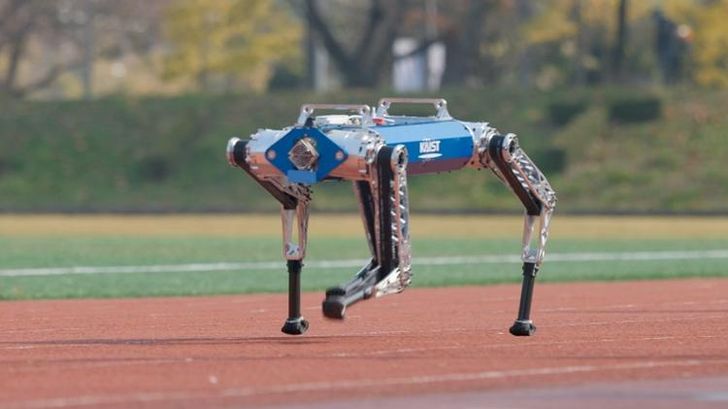
The Korea Advanced Institute of Science and Technology (KAIST) has announced that its AI robot, KAIST Hound, has set a new world record for a quadruped robot by breaking the 100-meter sprint record. Developed by the Dynamic Robot Control and Design Laboratory at KAIST, Hound achieved this feat by recording a remarkable time of 19.87 seconds on an outdoor track at the institute’s campus in Daejeon on Oct. 26. This achievement has been acknowledged by Guinness World Records.
Aside from this outdoor record, KAIST Hound has also made strides towards potentially clinching a second world record in an indoor setting. During a treadmill test, the robot reached a maximum velocity of 6.5 meters per second, surpassing the previous record set by the Cheetah 2, developed by the Massachusetts Institute of Technology, which had a speed of 6.4 meters per second. The team, led by Prof. Park Hae-won, is now awaiting confirmation from Guinness World Records for this indoor feat.
The impressive performance of Hound can be attributed to its advanced AI technology, particularly reinforcement learning, a data-driven mechanism that enabled the robot to develop efficient sprinting techniques. The robot’s self-learning system was meticulously programmed by the research team by setting maximum torque for its motor and implementing a velocity enhancement system. Additionally, efforts were made to optimize the robot’s movement by ensuring the even distribution of motor output to its legs for a balanced and symmetrical gait.
Furthermore, KAIST Hound’s design features lightweight materials in its legs to reduce overall weight and enhance its agility during sprints. Prof. Park Hae-won emphasized that Hound’s success underscores Korea’s leading position in both robot hardware and AI-driven robotics. Prof. Park, an expert in dynamic robot systems, legged locomotion robots, and bio-inspired robots, has highlighted the global significance of this achievement in showcasing Korea’s technological prowess in the field.
The research and development of Hound were supported by the Agency for Defense Development under the Defense Acquisition Program Administration of South Korea, which provided funding in 2019 for the advancement of new defense technologies. By pushing the boundaries of robotic capabilities, KAIST is setting a new standard in the field of robotics and artificial intelligence.
About the Author