Welcome to nature.com. For the best browsing experience, we recommend using an updated browser with full CSS support. You can also disable compatibility mode in Internet Explorer to improve your browsing experience. While we are displaying the site without styles and JavaScript, we appreciate your visit.
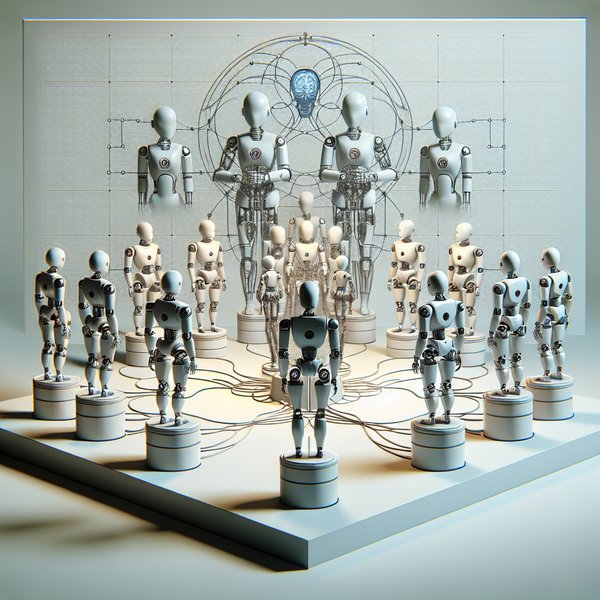
In an exciting development unveiled in Tokyo in 2024, Shigeo Yoshida showcased a group of small cylindrical robots on wheels that can be controlled by hand gestures, moving collectively like a school of fish. These swarm robots, imbued with artificial intelligence, have the potential to revolutionize human capabilities beyond physical limitations. By coordinating their actions, they can form patterns and collaborate to manipulate larger objects.
As a principal investigator in the Integrated Interaction Group at OMRON SINIC X (OSX), Yoshida is examining how swarm robots, despite being physically distant from the human body, could function as extensions of our bodies. He envisions a range of practical applications, from enhancing search-and-rescue missions by accessing tight spaces to potentially assisting in medical procedures like tumor removal in the future.
The concept of human-controlled swarm robots opens up possibilities for reshaping our interactions with technology. By mimicking human body shapes and functions, these robots can perform tasks such as debris removal or surgical interventions intuitively. Yoshida aims to explore how individuals perceive and interact with swarm robots, examining whether they view them as separate entities or extensions of themselves.
OSX is actively collaborating with universities and research institutes to develop AI technologies that promote human wellbeing. Atsushi Hashimoto, a key figure in OSX’s Knowledge Computing Group, emphasizes the importance of enabling smooth interactions between AI agents and humans through natural language processing. Their Vision-Language Interpreter (ViLaIn) facilitates the translation of visual and language inputs into actionable plans for robots, enhancing user experience and agency.
Apart from swarm robotics, OSX is also focused on improving the performance of robots in tasks where they currently face challenges, such as assembly processes. The development of soft robots like Saguri-bot is aimed at enhancing safety and cooperation between humans and machines in shared workspaces. Masashi Hamaya, a leading researcher at OSX, believes that integrating human-like attributes into robots will be pivotal for fostering harmonious human-robot collaborations in diverse industries.
In conclusion, the ongoing research at OSX underscores a commitment to advancing AI technologies with a focus on physical embodiment and sensory capabilities. By incorporating elements of humanness into robots and facilitating seamless communication between humans and machines, the goal is to enable effective and collaborative interactions that benefit society as a whole.
About the Author