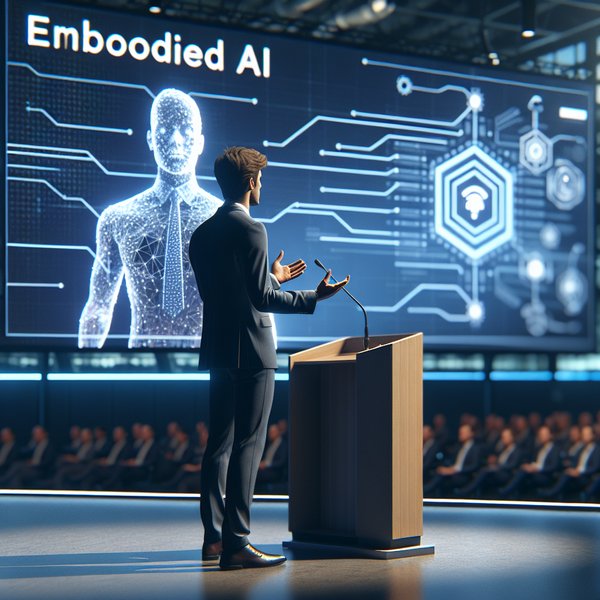
ZTE Corporation, a renowned global provider of integrated information and communication technology solutions, recently announced that Wang Xiang, Senior Vice President and Chief Strategy Officer, delivered a keynote speech at the World Internet Conference (WIC) held during MWC Barcelona 2026. In his address titled “Human–Machine Symbiosis, Intelligence Igniting a New Journey,” Wang Xiang shared ZTE’s vision for embodied AI and its industrialization pathway.
He discussed ZTE’s systematic approach to embodied AI, emphasizing the importance of Sensing, Communication, Computing, AI, and Control, along with the innovative “Point-Line-Plane” deployment path adopted at the company’s Binjiang manufacturing base. Wang Xiang highlighted the industry’s movement towards scaled commercialization driven by cost and efficiency optimization.
The shift from generative AI to physical AI was a key point of discussion, illustrating the evolution from “disembodied” intelligence in the digital realm to integrated “embodied” intelligence in the physical world. Embodied AI, seen as the driving force of the physical AI era, not only connects digital intelligence with the physical environment but also offers substantial value in industrial manufacturing, logistics, services, and various sectors, with the market forecasted to surpass USD 40 billion by 2030.
However, obstacles exist on the path to scaled commercialization, such as the challenges of agile deployment in dynamic workstations, coordinating heterogeneous agents for efficient production lines, and integrating intelligent production lines with business operations seamlessly. Overcoming these barriers is crucial for embodied AI to evolve from a concept to a productive tool that drives business decisions effectively.
ZTE has taken proactive steps to address these challenges by leveraging its Binjiang manufacturing base as a blueprint for advancing Embodied AI applications through the “Point-Line-Plane” pathway. This strategy involves optimizing functionality, flexible combination, and replicating deployment across multiple sectors to accelerate the commercialization and maturity of Embodied AI.
At the “point” level, ZTE integrates Sensing, Communication, Computing, AI, and Control to create single-unit applications, utilizing full-stack solutions for rapid assembly of versatile embodied agents tailored to specific tasks. The utilization of proprietary technologies like the Lanyue A1 SoC and OpenNewStar OS enables enhanced picking speed and motion control capabilities.
The company employs the Co-Sight Super AI Agent at the “line” level to connect intelligent nodes seamlessly and overcome collaboration challenges among heterogeneous agents. At the “plane” level, ZTE relies on its Digital Nebula 4.0 platform to coordinate factory business flow and facilitate real-time decision-making, resulting in significant improvements in output value, production efficiency, and delivery cycles.
ZTE’s commitment to core competitiveness in Sensing, Communication, Computing, AI, and Control, combined with a balanced approach of proprietary R&D and ecosystem partnerships, underscores its dedication to advancing embodied AI. By fostering open collaboration and driving independent innovation in key technologies, ZTE aims to lead the industry towards a future of human-machine symbiosis and a brighter digital landscape.
In conclusion, ZTE’s relentless pursuit of innovation and collaboration with global partners exemplify its dedication to shaping the future of AI and technology, promising a transformative journey towards human-machine symbiosis and enhanced digital experiences.
About the Author