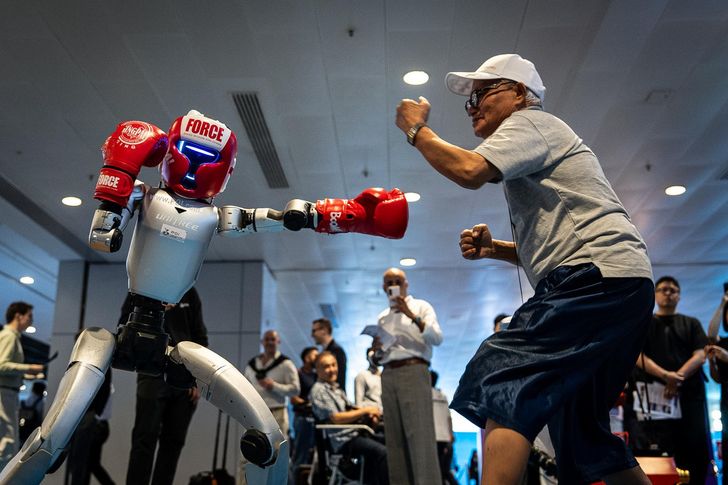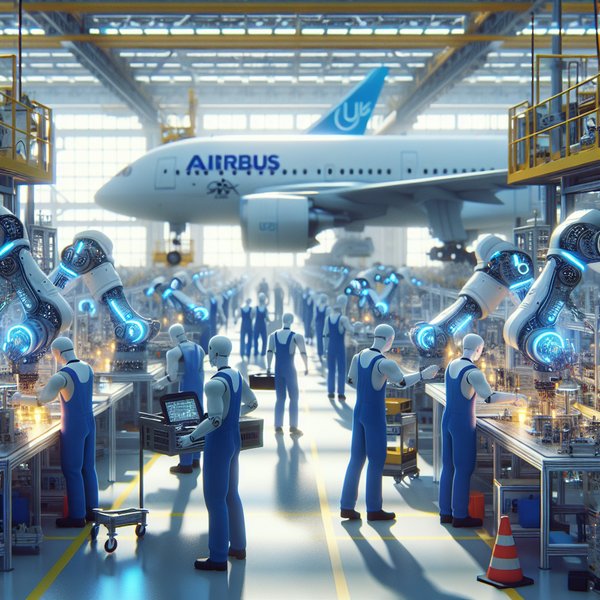
Airbus, the European aviation giant, has made a strategic move by adopting automation in its assembly lines through a partnership with Chinese robotics developer UBTech Robotics. This step represents a significant shift in global manufacturing trends. Airbus has procured the state-of-the-art “Walker S2” humanoid robots for their industrial operations. Unlike Western companies that often focus on prototypes, Chinese “unicorn” companies like UBTech Robotics are rapidly expanding into practical production environments.
The Walker S2 robot, designed for industrial applications, stands at 5 feet 9 inches (176 cm) tall, weighing 154 lbs (70 kg), making it a robust and versatile robot. With a speed of 4.5 mph (2 meters/second) and highly dexterous hands offering 11 degrees of freedom, it can firmly grasp items weighing up to 16.5 lbs (7.5 kg) in each hand. The robot’s pivotal waist, enabling almost 180 degrees of rotation, allows it to work effectively on various parts without the need to adjust its position, ideal for compact assembly spaces.
One of the standout features of the Walker S2 is its innovative battery-swapping capability, a unique feature among humanoid robots as of late 2025. This feature enables the robot to operate continuously without extended charging breaks, enhancing productivity on the assembly lines. UBTech Robotics has already shipped around 1,000 units, positioning itself as the third-largest robot supplier globally behind Agibot and Unitree.
The price estimate for a Walker S2 stands at approximately $112,000, with expectations for cost reduction as production scales up. The strong demand is evident as UBTech received orders worth 1.4 billion yuan ($201 million) in the previous year. Investors responded positively to the Airbus-UBTech collaboration, with UBTech shares surging by 6.76% in Hong Kong trading post-announcement.
UBTech aims to reach a production capacity of 5,000 units in 2026 and a target of 10,000 units by 2027. The partnership between Airbus and UBTech will involve validating these robots for high-precision tasks in safety-critical environments, joining similar successful deployments with companies like Texas Instruments, BYD, and Foxconn.
Experts predict that the widespread adoption of humanoid robots will commence in 2028, highlighting the transformative impact of this technology. The progress made by China in robotics positions it as a frontrunner in the global race towards advanced automation. The implications of this advancement are profound and indicate a new era in manufacturing and industrial processes.
About the Author