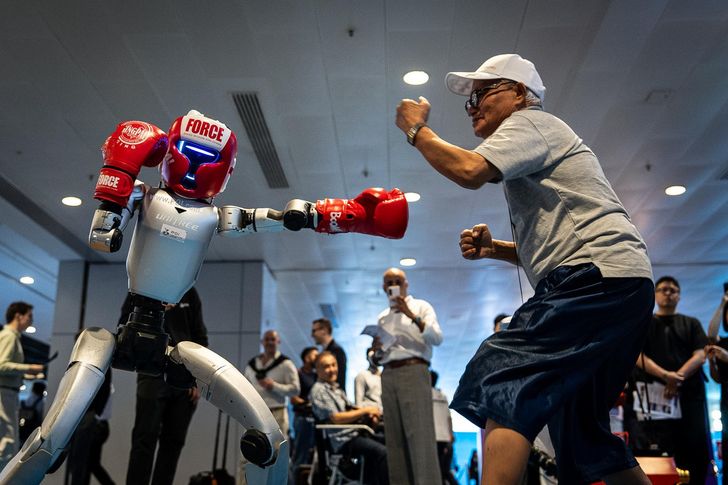
In 2025, the race for robots accelerated, especially in the realm of humanoid models. Over the past months, various manufacturers have unveiled their offerings designed for use in factories and homes, featuring companion robots and domestic assistants. Companies like Tesla, Figure AI, Boston Dynamics, Apptronik, Unitree, and LimX Dynamics showcased the capabilities of their robots, from dancing, performing parkour acrobatics, battling in arenas, executing kung fu moves, to doing household chores. Despite the excitement, new concerns have arisen, such as fears of job displacement for humans or a potential bubble in the humanoid robot sector, with warnings coming from China.
Nonetheless, several standout models were revealed this year that caught everyone’s attention. In 2026 fast approaching, it’s important to highlight the models that excelled in terms of intelligence, capabilities, cuteness, or eerie appearance. China has been significantly investing in humanoid robot development, with Unitree gaining prominence for its mesmerizing acrobatic models. The G1 model stole the show at Web Summit 2025 in Lisbon, and this year, the manufacturer unveiled an even more agile version, the R1. Priced at $5,900, the R1 is more affordable than the G1 and is geared towards developers, researchers, educational institutions, and tech enthusiasts with deep pockets.
The field of robotics has faced challenges replicating the sense of touch, but Vulcan, developed by Amazon, has overcome this obstacle. Vulcan can sense its surroundings to navigate shelves, identify products, and select items in the company’s distribution centers. Equipped with a special tool on its arm and a set of sensors measuring pressure, Vulcan can handle objects without damage. Amazon plans to deploy Vulcan in its US and European distribution centers. The company has also established a team dedicated to developing AI agents for robotic operations to enable robots to listen, understand, and act based on natural language interactions.
Tesla’s humanoid robot had a mix of highs and lows in the year. While showcasing its latest version’s abilities on the dance floor, in household tasks, and even at a movie premiere, incidents like a recent fall at an event raised autonomy concerns. Despite this, Tesla aims to launch the third generation of Optimus in the next year, which Elon Musk claims will be incredibly advanced. Xpeng also introduced the latest version of its humanoid robot IRON, which sparked intrigue, with many questioning its human-like appearance.
Home humanoid robots are poised to be a major trend in the coming years. The NEO from 1X Technologies aims to stand out, with features such as assisting with household chores and unboxing gadgets. Similarly, Clone Robotics showcases humanoid robots with synthetic humans, equipped with synthetic organs mimicking human skeletal, muscular, vascular, and nervous systems. On the more friendly side, the AI ME introduced by TCL at IFA 2025 captivated visitors with its adorable and endearing design, targeted as a smart companion for children.
In the realm of robotics with a friendly appearance, the Reachy Mini developed by the AI platform Hugging Face aims to enhance the use of development tools, offering interactive communication with users. This compact model is designed for desks or kitchen counters, enabling access to thousands of pre-developed AI models and creating new applications using Python. With two versions available, the Reachy Mini lite is priced at 266 euros, catering to a wide range of users.
In conclusion, the advancements in humanoid robotics in 2025 have showcased a wide array of capabilities and applications, paving the way for an exciting future where human-like robots will play a significant role in various industries and households.
About the Author