Welcome to nature.com. We appreciate your visit. Your current browser may have limited support for CSS, impacting your browsing experience. For optimal use, we recommend updating your browser or disabling compatibility mode in Internet Explorer. While we work on improving our site, we are displaying content without styles and JavaScript.
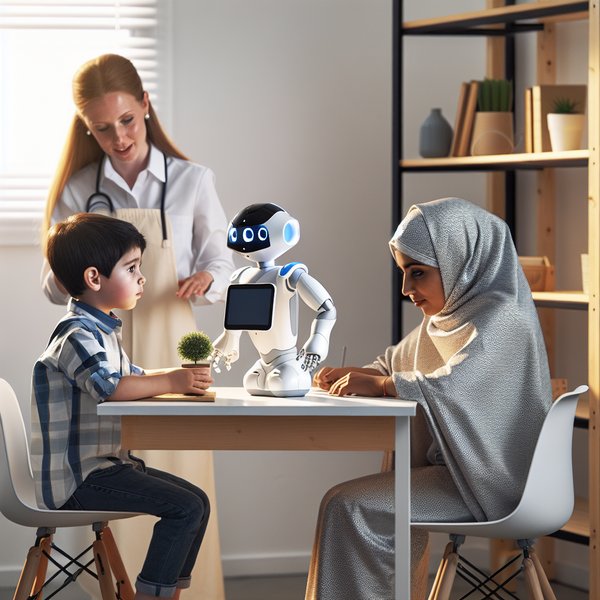
In this study, we explore child-robot interaction (CRI) within educational settings, focusing on children aged 5 to 8 years. The research compares how children engage with a robot versus a human instructor during a tangram learning task. By examining interactions like eye gaze, social referencing, and vocalizations, we aim to understand how children’s characteristics relate to their behaviors with instructors.
Findings reveal that children tended to gaze more at the robot instructor and display more social referencing towards a research assistant while interacting with the robot. Age influenced task completion time, while other individual traits showed limited connection to behavioral responses to instructors. Preferences and perceptions assessed after the tasks indicated children preferred interacting with the robot, emphasizing implications for incorporating social technologies in education.
The study underscores the importance of individual differences in how children respond to robots, especially in educational contexts. For further information or data access, feel free to contact the corresponding author, Allison Langer, at Allison.langer@temple.edu.
This manuscript is provided in an unedited version to grant early access to findings, with final publication pending further editing. It emphasizes the rapid growth of CRI and its potential in providing personalized educational support. Acknowledgments go to all participants and dedicated research assistants involved in this project.
For more details and references, kindly refer to the full article.
About the Author