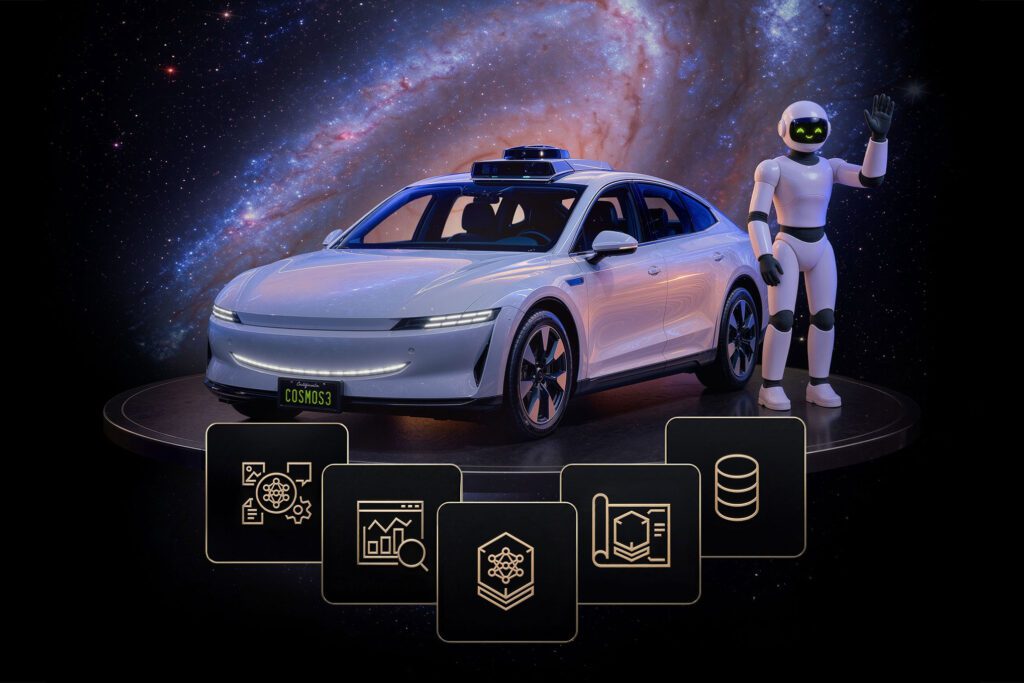
Nvidia has introduced Cosmos 3, a cutting-edge model for physical AI intended to streamline training cycles in areas such as autonomous vehicle (AV) development, robotics, and vision AI. This open world foundation model utilizes a unique mixture-of-transformers architecture to enhance vision reasoning, world simulation, and action prediction within a single system. By compressing the time needed for AI training and evaluation from months to days, Cosmos 3 offers significant benefits to developers.
The model combines a reasoning transformer with an expert generation transformer, enabling it to grasp object interactions, motion, and spatial-temporal relationships before generating video and action outputs. Trained on a vast multimodal physical AI dataset encompassing text, image, video, sound, and action trajectories, Cosmos 3 aims to revolutionize the way robotics and AV systems are built and operated.
Nvidia’s collaboration with the Cosmos Coalition, comprising Agile Robots, Black Forest Labs, Generalist, LTX, Runway, and Skild AI, signifies a strategic move towards advancing open world models. AV developers like Li Auto are leveraging the Cosmos platform, which now includes new datasets covering autonomous driving, robotics, and spatial reasoning.
Jensen Huang, Nvidia’s founder and Chief Executive, emphasized the significance of physical AI breakthroughs in realms like multimodal reasoning language, vision, and world models. Cosmos 3 emerges as a pivotal element underlying various tools announced by Nvidia recently, indicating a holistic approach towards the development of physical AI technologies.
The strategic decision to release Cosmos 3 as an open model is not merely an act of generosity but a calculated move to solidify Nvidia’s architecture as the go-to choice for developers. By providing a frontier foundation model free of charge, Nvidia aims to accelerate the adoption of its platform over competitors. The wide-ranging applications of Cosmos 3 across robotics, AVs, and industrial vision AI offer developers access to cross-domain training data and architecture at an unparalleled scale.
In conclusion, Nvidia’s Cosmos 3 model represents a significant step towards advancing physical AI capabilities in various industries. With its innovative architecture and extensive dataset, Cosmos 3 is poised to reshape the future of mobility by enabling developers to create robots, autonomous vehicles, and vision AI systems that can effectively perceive, reason, plan, and act in real-world scenarios.
About the Author