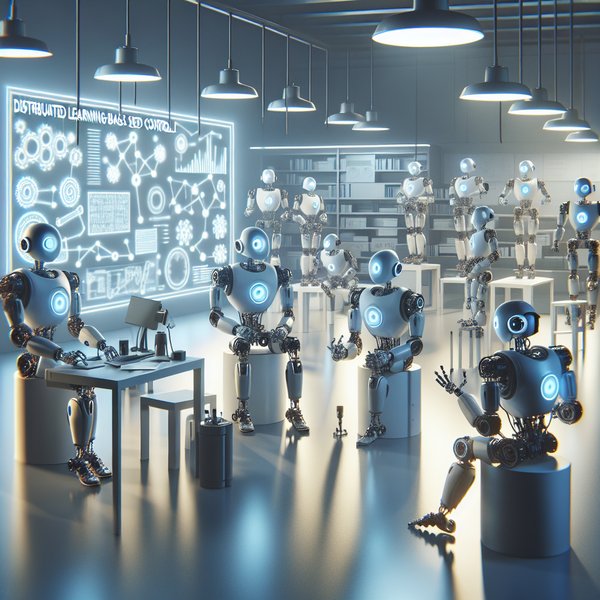
Multi-robot systems are a vital component of multi-agent systems, where numerous robots collaborate to accomplish tasks that surpass the capabilities of a single agent. These systems operate through decentralized or distributed mechanisms, relying on local interactions to bring about collective behaviors despite limited information and communication. Although traditional methods have greatly contributed to our understanding of coordination, information flow, and connectivity maintenance, they often struggle to adapt to dynamic and uncertain environments due to their reliance on rigid modeling assumptions.
The emergence of machine learning has opened up new possibilities for enhancing multi-robot systems by enabling agents to learn coordination strategies from data. This approach fosters adaptability and robustness in scenarios characterized by partial observability and noisy sensing. Nevertheless, current learning-based frameworks frequently overlook the importance of explicit communication, which is crucial for achieving scalable coordination among multiple robots and has been a fundamental aspect of control-theoretic strategies.
To bridge this gap, this dissertation introduces hybrid methodologies that merge learning with communication-aware distributed control. By blending the generalizability and flexibility of machine learning with the proven principles of control theory, this research enhances the fundamental concepts of collective decision-making. Moreover, it contributes to the development of communication-aware, learning-based multi-robot systems that hold promise for practical application in real-world settings.
For further details on this research, the original article can be found at the following link: [https://theses.hal.science/tel-05549372](https://theses.hal.science/tel-05549372).
About the Author