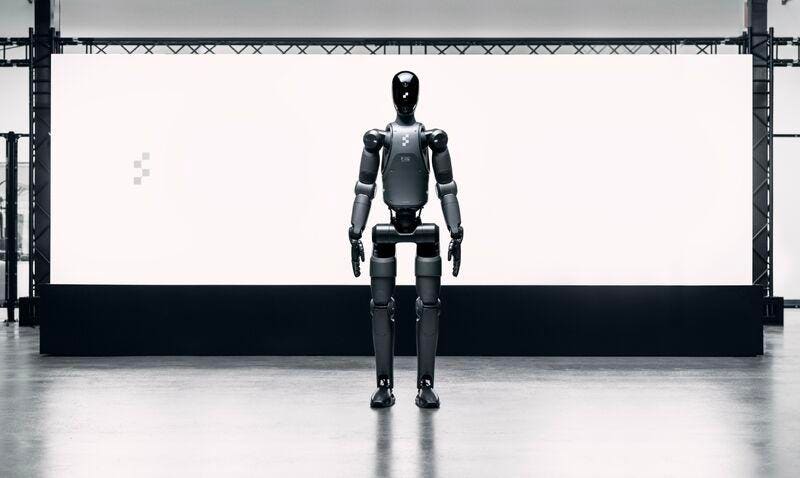
The CEO of a prominent manufacturer specializing in humanoid robots has announced that the company has secured a significant commercial contract with a major U.S. corporation. Brett Adcock, the CEO of Figure, revealed plans to potentially deliver up to 100,000 humanoid robots within the next four years, with a strong emphasis on the commercial and home markets. This recent development underscores Figure’s growing presence in the robotics industry.
Adcock highlighted the strategic importance of securing high-volume shipments to drive down costs and bolster AI data collection capabilities for the company. The addition of a new major U.S. client, alongside a previous announcement in December, presents a promising path towards achieving the ambitious target of 100,000 robots over the coming years.
Recently, futurist and engineer Peter Diamandis recognized Figure as one of the top contenders among 16 leading companies in the development of usable and cost-effective humanoid robots. Diamandis, who disclosed his venture fund’s investment in Figure, commended the company for rapidly introducing its first robot, Figure 01, within a short period after its inception. The ongoing evolution of Figure’s models, with Figure 02 currently in production and Figure 03 in development, demonstrates the company’s commitment to innovation.
Figure’s integration of artificial intelligence (AI) plays a crucial role in enabling the robots to adapt and learn new tasks efficiently. Adcock highlighted the successful implementation of neural networks in training robots for specific use cases, emphasizing the transformative impact of AI technology on Figure’s operations.
The company’s relentless pursuit of enhancing robot performance is evident in the significant speed improvements achieved between Figure 01 and Figure 02 models. With Figure 03 expected to surpass its predecessors in speed and capability, Figure aims to stay at the forefront of humanoid robot development.
Adcock’s approach of selectively nurturing relationships with a few key clients aligns with Figure’s expansion strategy, focusing on deepening engagement with large customers rather than rapid acquisition of new clients. The undisclosed identity of Figure’s second major customer, in addition to BMW, invites speculation that it could be a prominent U.S. entity like Walmart, Amazon, Apple, or leading healthcare companies.
The broader application of humanoid robots in diverse sectors, including healthcare, logistics, and manufacturing, underscores the growing demand for advanced robotics solutions. The transition of humanoid robots from research labs to practical deployment signifies a pivotal phase for both companies and manufacturers in refining and advancing robot capabilities. As Adcock emphasizes, real-world deployment is instrumental in accumulating valuable data for AI advancements and enhancing robot functionalities.
Notable players in the humanoid robot industry, such as Agility Robotics, Telsa, Unitree, and Sanctuary AI, alongside international competitors, are reshaping the landscape of robotic technology. The momentum towards widespread adoption of humanoid robots underscores the transformative potential these innovations hold for various industries in the near future.
About the Author